ETIH Innovation Awards Winners: Blackboard wins Best Digital Learning Platform for Higher Education
Blackboard was recognized for combining AI innovation, accessibility, analytics, and measurable institutional impact in a cloud-based learning platform for higher education.
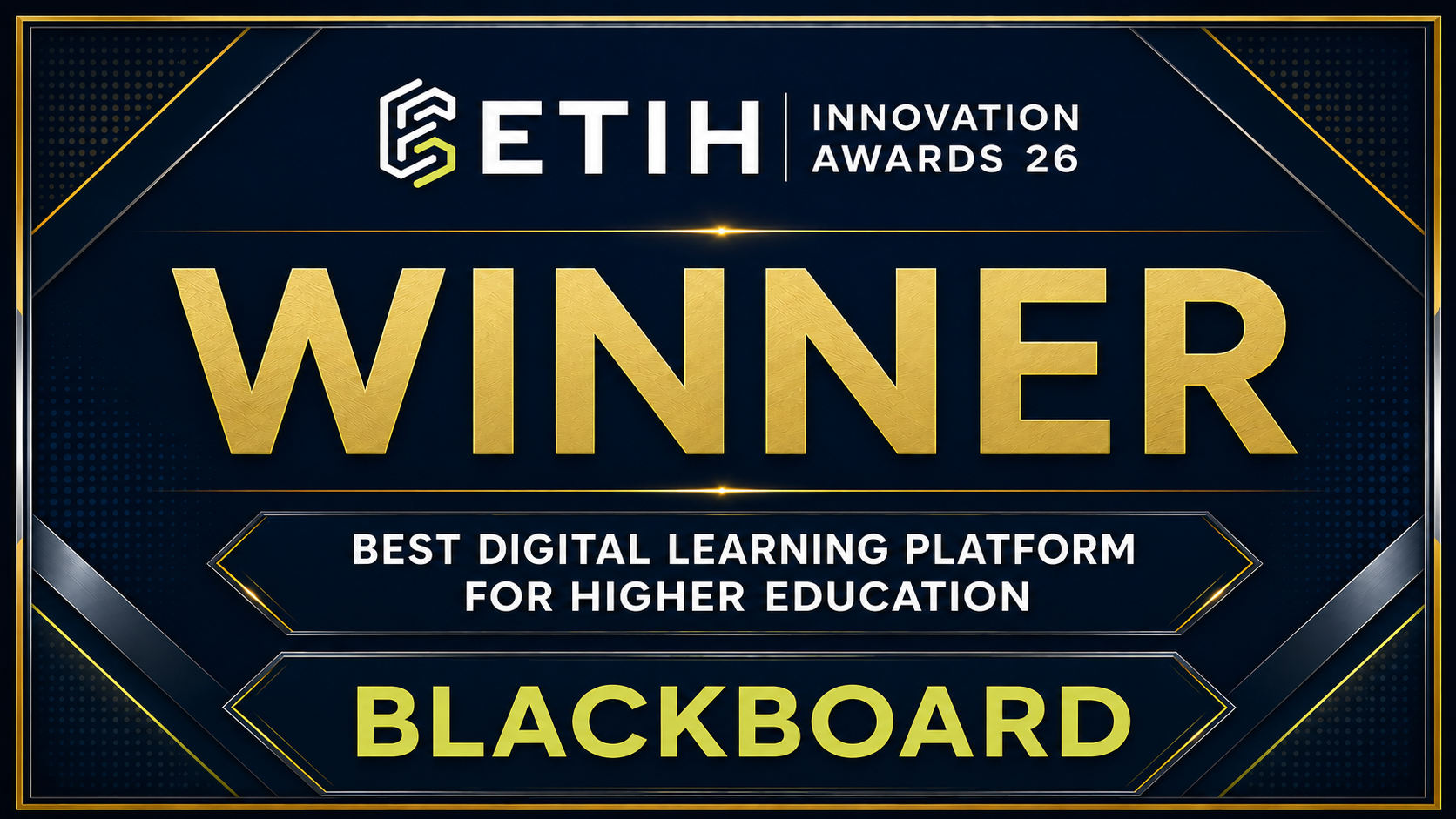
Blackboard won Best Digital Learning Platform for Higher Education at the inaugural ETIH Innovation Awards 2026
Blackboard has won Best Digital Learning Platform for Higher Education at the inaugural ETIH Innovation Awards 2026, with judges highlighting its platform maturity, AI capabilities, accessibility focus, and evidence of adoption across higher education institutions.
The award recognizes Blackboard’s work to redefine the role of the learning management system in higher education at a time when institutions are facing pressure around enrollment, resources, accessibility, student outcomes, and responsible AI adoption.
Blackboard’s recent innovation work has focused on reducing friction for educators while improving student engagement. Its platform includes AI Design Assistant, AI Conversation, accessibility tools through Ally, analytics integrations, competency-based learning features, badging, and micro-credentials.
For Dom Gore, EVP of Product at Blackboard at Blackboard, the connection between faculty efficiency and student engagement is central to the company’s approach. In practice, that means treating workload reduction as part of the student experience, rather than a separate operational issue: “Because in real teaching environments, those goals are inseparable. Faculty cannot create more engaging learning experiences if they are overwhelmed by administrative burden and time-consuming course design tasks.”
That point was central to the judges’ decision. ETIH Innovation Awards judge Richard Govada Joshua pointed to Blackboard’s combination of “higher education relevance, platform maturity, AI innovation, accessibility, institutional scale, and measurable operational impact.” He also noted that “AI Design Assistant directly addresses faculty workload, course design, assessment creation, rubrics, and content development.”
Rather than positioning AI as a separate layer, Blackboard’s entry focused on how AI can reduce routine workload while leaving educators in control of teaching decisions.
Gore frames that as a practical design priority: “Our focus has been on removing the barriers that get in the way of good teaching. When we make it easier for educators to build courses, create rubrics, design activities, identify accessibility issues, and understand student progress, we are giving them more time and capacity to focus on the human work of teaching: connection, feedback, guidance, and support.”
AI tools built around faculty workload
Blackboard’s AI Design Assistant was one of the clearest examples of measurable impact in the entry. The tool helps instructors generate course structures, learning modules, test questions, authentic assessments, and rubrics, reducing course development time while keeping faculty oversight in place.
ETIH Innovation Awards judge Al Kingsley called Blackboard “a genuine Higher Ed heavyweight backing up its claims with proper institutional data.”
Gore explains that faculty adoption was strongest when AI was positioned as support for professional expertise, not a replacement for it: “One of the biggest lessons has been that faculty want AI to support their expertise. Adoption was strongest when the tools helped instructors move faster, generate ideas, or reduce repetitive work while still allowing them to remain fully in control of the learning experience.”
That balance between automation and academic control was a recurring theme in the entry. Blackboard’s AI tools were positioned as practical support for course design, assessment creation, rubrics, and content development, rather than as a replacement for instructor judgment.
Gore notes that faculty engagement increased when the tools addressed problems educators were already trying to solve: “Faculty responded positively because the tools addressed real pain points: building assessments, structuring courses, creating rubrics, and developing content.”
Emma Thompson, Director of Content and Editor at ETIH, says: “Blackboard stood out because the entry connected AI innovation to the realities of higher education delivery. The judges were not looking for AI features in isolation. They were looking for evidence that technology could reduce workload, support better learning design, and help institutions respond to pressure around quality, accessibility, and outcomes.”
From passive content to guided interaction
Blackboard’s AI Conversation feature added a second dimension to the entry by focusing on student engagement and AI literacy. The tool allows students to engage in guided, reflective dialogue with AI personas under instructor oversight, with use cases across healthcare, teacher education, and business.
The reported usage was significant. Students sent 2.92 million messages through AI Conversation, with 209,000 unique students using the tool across 575 institutions globally.
Govada Joshua highlighted that scale as evidence of learner impact, noting that Blackboard showed “adoption and active engagement at scale.” He also said the platform was not a narrow single-program innovation, but “a comprehensive learning ecosystem embedded into real higher education delivery.”
Gore explains that guided AI interaction has a different role from open-ended AI use because it can be built around defined learning outcomes: “Guided AI interaction has the potential to make learning more active, reflective, and personalized, especially when it is designed with strong pedagogical intent. The value is not simply that students can ‘chat’ with AI. The value is that they can engage in structured scenarios, practice decision-making, test their understanding, and reflect on their reasoning in a safe and guided environment.”
That emphasis on structured interaction was also picked up by ETIH Innovation Awards judge Catherine Buckler, who said the benefits for students and staff were clear. She noted that staff were able to innovate while reducing workload, while students particularly benefited from “the opportunity for real world simulations in medical / education courses.”
Gore adds that AI Conversation is designed to keep faculty involved in the learning process, rather than moving students into unsupported interaction with AI: “AI Conversation is a good example of how AI can support deeper learning without removing the instructor from the process. Faculty can design the interaction, define the goals, shape the scenario, and use the student’s reflection as part of the learning experience.”
That approach supports a broader shift away from passive content consumption. In disciplines where students need to practice communication, judgment, ethical reasoning, or workplace scenarios, Gore points to the value of using AI for structured rehearsal and reflection: “Students can engage with a patient, client, historical figure, business stakeholder, or other persona, then reflect on what they learned and how they approached the situation.”
Responsible AI and measurable value
Responsible AI was another factor in the judges’ decision. In a higher education market where institutions are still developing AI policies and practices, Blackboard’s entry emphasized educator control, accessibility, transparency, and collaboration with institutions.
Gore argues that higher education providers now need more than AI features from technology partners: “Higher education institutions need clarity, trust, and practical partnership. Many institutions are not asking whether AI matters anymore; they are asking how to implement it responsibly, sustainably, and in ways that genuinely improve learning.”
That framing helped separate Blackboard’s entry from products focused mainly on AI capability. The company positioned its AI development as part of a wider platform strategy that includes accessibility, analytics, learning design, institutional insight, and student support.
Gore explains that technology partners need to support institutions with flexibility, safeguards, and pedagogy: “Institutions need transparency around how tools work, flexibility in how they are used, and safeguards that protect academic integrity, accessibility, and human oversight. They also need solutions that are grounded in pedagogy rather than technology for technology’s sake.”
Neil Almond, ETIH Innovation Awards judge, described Blackboard as offering a powerful higher education platform in a market where institutions need practical routes to improve delivery, engagement, and student support.
For Blackboard, the award recognizes both the platform and the teams behind its development. Gore reflects on the cross-functional work behind the win: “This recognition means a great deal because it reflects the work our teams have been doing to deliver innovation that is practical, responsible, and directly connected to the needs of institutions, educators, and learners.”
He also positions the win as recognition of Blackboard’s wider product philosophy, not just a single set of features: “For Blackboard, this award is not just recognition of a platform. It is recognition of a philosophy: that technology should make teaching and learning easier to deliver, easier to improve, and easier to prove.”
As higher education institutions continue to evaluate AI, Blackboard’s winning entry showed how a mature learning platform can combine automation, instructor oversight, accessibility, and measurable operational value.
Gore says the team sees the award as validation that Blackboard is focused on the right priorities: “Winning Best Digital Learning Platform for Higher Education is a proud moment for the team. We see it as validation that Blackboard is focused on the right priorities: meaningful innovation, responsible AI, accessibility, and measurable value for institutions.”
If you want to find out more about Blackboard, its learning platform, and its AI-supported higher education tools, more information is available via the company’s website.