ASU and will.i.am co-design agentic AI course centered on learning by building
Arizona State University is developing a new undergraduate course with will.i.am that asks students to learn AI by building personal agentic systems, blending experimentation, ethics, and product development into a credit-bearing higher education experience.
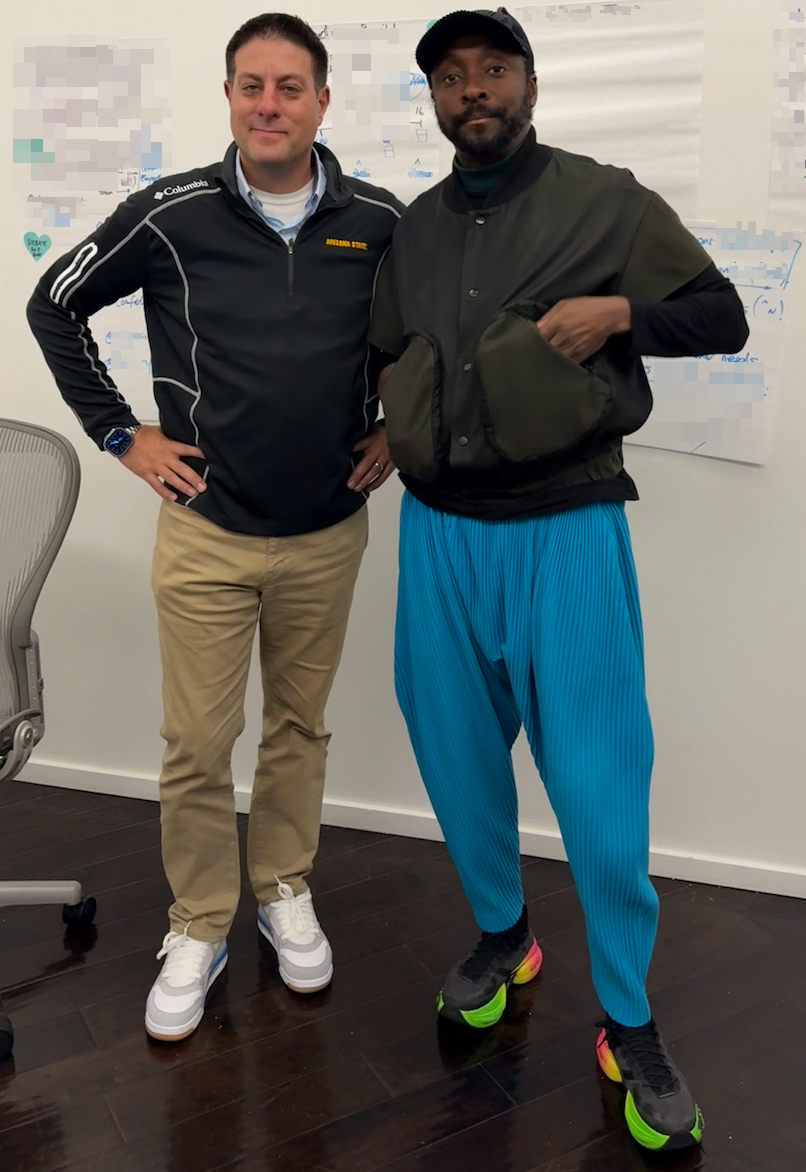
Dr. Sean Hobson and will.i.am
Arizona State University is launching a new undergraduate course co-designed will.i.am that aims to rethink how students learn artificial intelligence by placing creation, experimentation, and agency at the center of the curriculum.
The course, titled Agentic Self, is being developed by Sean Hobson, Ph.D., Chief Design Officer and Clinical Assistant Professor at ASU. In a LinkedIn post and accompanying article, Hobson describes the project as an early-stage experiment that deliberately blurs the boundaries between a university course, a creative lab, and a research sprint. “Nothing about this feels like a traditional job,” he writes. “It’s more like standing inside a creative lab, a research sprint, a university department, and a startup all at once.”
Learning AI by building an agentic self
Agentic Self is designed as a credit-bearing undergraduate experience where students learn AI fundamentals by actively designing, training, and questioning their own agentic AI systems. Hobson emphasizes that the course moves beyond narrow chatbot use cases toward something more personal and long-term.
He writes that the aim is for students to build “an extension to their own lifelong Agentic AI companion,” describing it as “a digital extension of their creative identity, curiosity, and goals,” with “students and humanity at the center vs. other interests.”
According to Hobson, students will learn “what makes AI agentic, how to design and train personal AI systems, how to align AI to purpose, ethics, creativity, and community,” while working on projects “that are impossible without a personal agent by their side.”
To support this work, each student will use a dedicated NVIDIA GPU, allowing them to retain control over their data, privacy, and creative artifacts. Hobson notes that this infrastructure is intentional, writing that it ensures students maintain ownership over their work rather than relying on opaque systems.
EDU.FYI and product development as curriculum
At the center of the course is EDU.FYI, a new product ASU is co-developing with FYI.AI and will.i.am. Hobson explains that the full product development lifecycle will function as the curriculum itself.
“Every part of the product development life cycle — from discovery to design, modeling, training, iteration, and deployment — becomes a learning pillar within the course,” he writes. Rather than observing how AI products are built, students will “participate in building one.”
Throughout the semester, a rotating group of contributors, including designers, academics, technologists, musicians, and entrepreneurs, will engage with students to explore questions of “agency, identity, creativity, and the human-AI future,” while also influencing the evolving EDU.FYI platform.
The course will initially bring together students in Los Angeles and Arizona, with plans to expand to fully online participation. Hobson notes that learners will collaborate across locations and meet weekly while building an agentic system they can continue developing after the semester ends.
Learning alongside uncertainty
Hobson is explicit that Agentic Self is designed to be uncomfortable by traditional academic standards. “You can’t design the future of learning from a safe distance,” he writes, adding that progress requires being “ok with the messy cables and troubleshooting your way to discoveries.”
He describes the course as intentionally open-ended, expecting “questions with no answers, pivots we didn’t see coming, and discoveries we couldn’t predict.” For Hobson, this uncertainty is not a flaw. “That’s not a bug or vulnerability — it’s a feature of the learning design model,” he writes.
Referencing long-standing ideas about creativity in education, Hobson also cites Sir Ken Robinson’s observation: “If you’re not prepared to be wrong, you’ll never come up with anything original.”
Summing up the course philosophy, Hobson writes that Agentic Self is “not about one-way dissemination of content,” but about “team-based inquiry, experimentation, creativity, and agency.” He adds that the goal is to “convert teaching from a solo sport to a community-based research activity,” with students helping to shape future teaching and learning models in real time.
The course is scheduled to begin in Spring 2026, with Hobson indicating that further details will emerge as development continues.