Protecting student data beyond the classroom: The privacy risks schools often overlook
A Report Card Is Not the Only Thing Being Tracked
A parent checks a school portal to see grades and finds something else entirely. There is a login history. There is a list of assignments opened at midnight. There is a record of which videos a fourteen year old watched during study hall.
Families may not realise how much data is being gathered on their children quietly.
None of that shows up on a report card, yet all of it counts as student data, and most families never realize how much of it schools quietly gather.
Classrooms today run on software, not just textbooks. Attendance apps, learning management systems and grading platforms all collect student information the moment a child logs in. That volume of collection is exactly why a growing number of districts now consult services focused on data privacy compliance, since keeping personal data protected requires more than a single locked filing cabinet. When a family wants a clear picture of how a data broker might expose a student's or a parent's own information outside the school system, resources like clearnym.com walk through how a public profile gets built from scattered records and how a person can request its removal.
Why Schools Collect So Much in the First Place
Educators rarely set out to gather personal information for its own sake. Most data collection starts with a genuine goal. A teacher wants to know which students are struggling before a test reveals it too late. A counselor wants attendance data that flags a pattern before a student disappears from class entirely.
That intention matters, but it does not erase the risk. Once a system holds behavioral data alongside academic records, the file becomes far more revealing than a simple grade sheet ever was.
The Hidden Categories of Data Schools Actually Hold
Ask most parents what a school knows about their child and they will guess grades, maybe attendance. The real list runs longer.
Demographic data including age, home address and family structure
Attendance data tracked daily across every class period
Behavioral data logged through discipline systems and hallway monitoring
Academic records covering test scores, essays and learning outcomes
Digital activity captured by learning management systems, down to click timestamps
Seeing that list laid out tends to surprise people. Understanding student data means recognizing it rarely lives in one tidy file. It scatters across a dozen different platforms, each with its own login and its own privacy policies.
Where the Real Risk Begins
A single spreadsheet is manageable. A dozen disconnected systems are not. Every additional platform a school adopts becomes another place where a data breach can happen, and every vendor contract becomes another set of hands touching student records.
Small districts feel this pressure the most. Many run on tight budgets, and IT staff often manage security part time alongside a long list of unrelated duties. That gap between the number of platforms and the number of people watching them is where sensitive data quietly slips through.
Student Privacy Laws Were Not Built for Today's Classroom
Federal student privacy laws were largely written before cloud based learning tools existed. They still form the legal baseline schools follow, yet the technology those laws were meant to govern has changed dramatically since then.
Districts now layer state level rules on top of federal ones, and those state requirements vary widely. A school in one state might face far stricter limits on how vendors can use student data than a school just across the border. Keeping every classroom tool aligned with every applicable rule has become its own ongoing project rather than a box checked once a year.
The Vendor Problem Nobody Talks About Enough
A school might trust its own staff completely and still expose data through a third party. Free educational apps often fund themselves by analyzing usage patterns or sharing data with advertising partners, and the fine print rarely gets read closely by a busy teacher choosing a new classroom tool.
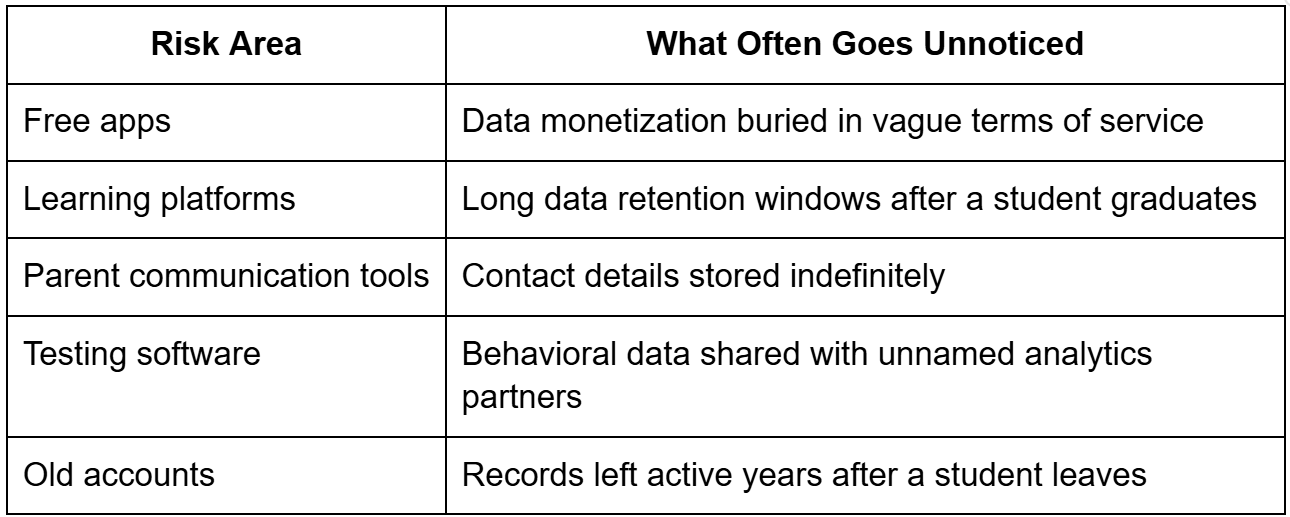
Reviewing this kind of table once a semester catches problems long before a parent has to ask uncomfortable questions.
How Good Data Practices Actually Support Learning
Privacy protections are not just about avoiding trouble. Done well, they support the very goals schools already care about. A district that can analyze data responsibly is better positioned to identify students who may need extra support before a struggling student falls further behind.
That kind of targeted help depends on trust. Families share more honestly with a school when they believe their child's information stays protected rather than scattered across unknown vendors.
Building a Sensible Data Program at the District Level
A workable approach does not require an enormous budget. It requires consistency and a clear starting point.
Inventory every platform that touches student information systems
Confirm each vendor contract states exactly how data should be used
Set retention limits so records do not linger after a student's enrollment ends
Train staff on what personal information from students should never be shared casually
Review data security settings on every tool at least once each school year
Districts that follow a routine like this tend to catch small issues before they turn into headlines.
What Families Can Do on Their Own
Schools carry most of the responsibility here, but families are not powerless. Asking a school directly which vendors receive a child's data is a reasonable question, not an intrusive one. Reviewing app permissions on a school issued device takes only a few minutes and often reveals more sharing than expected.
Parents who want visibility into how their own information might already circulate outside the school system can also check public data broker listings tied to their name, since student privacy concerns often connect to a household's broader digital footprint.
The Bigger Picture
Technology in classrooms is not going away, and it should not have to. The goal is to use the tools that're already available in a smart way with clear rules about what is gathered and the reason for it. A school district that sees student data privacy as something that happens every day not once a year creates a safer, more welcoming and helpful place, for every student who comes through its doors.
Conclusion
Protecting a student today means looking past the classroom walls. It means questioning every app, every vendor and every login that touches a child's information. Schools that build strong habits around data governance protect more than paperwork. They protect the trust families place in them every single day.
FAQ
Can a school legally share my child's data with an advertising company?
Generally no, though free tools sometimes include vague terms that allow limited data use for product improvement, which is why reviewing vendor agreements matters.
Does deleting a school app account remove all stored student records?
Not always. Many platforms retain records for a set period even after an account is deleted, depending on that vendor's own retention policy.
How can a parent find out which apps a teacher has approved for classroom use?
Most districts keep an approved software list available through the main office or the district website, and asking directly usually gets a quick answer.
Is behavioral data from discipline systems treated differently than academic data?
Yes, behavioral records often carry stricter access limits since they can be more sensitive than a simple test score.
Should families worry about old accounts from a school a child no longer attends?
Yes, inactive accounts are a common overlooked risk, and requesting deletion after graduation is a reasonable step for any family to take.