A Complete Roadmap to Success for New Software Developers
Finishing a software development course or degree program feels incredible. You've spent months grinding through syntax errors, late-night debugging sessions, and project deadlines. Now you’re done. Congratulations. So, what next?

Photo credit: Unsplash
Many new software developers assume that once they’ve finished the course, hundreds of job offers are just there waiting for them. Unfortunately, it doesn’t always work that way.
Of course, some people move into full-time employment. Others go into freelancing, become independent developers, and maybe launch startups that make some of the apps we use every day.
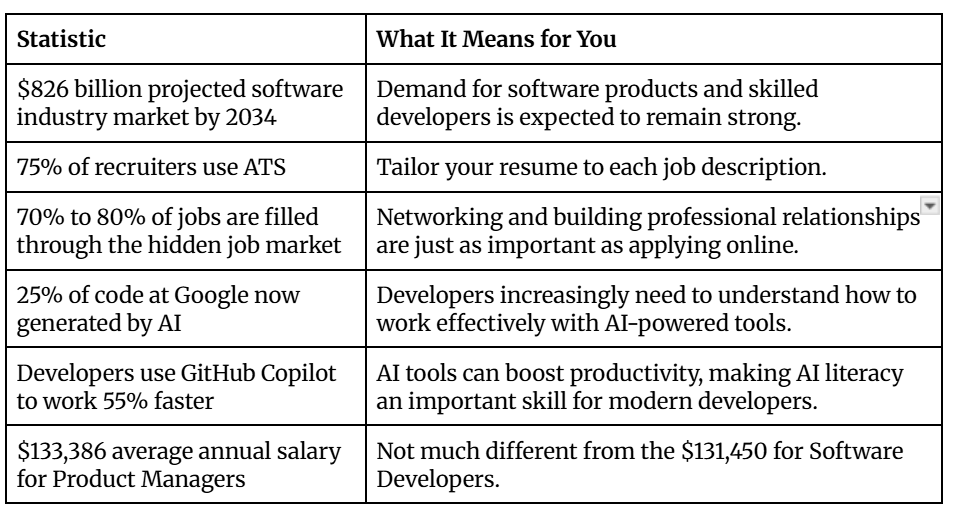
While there’s no one-size-fits-all approach to a career in software development, one thing is certain: the software talent is as strong as ever. In fact, industry experts predict that it will hit $826 billion by 2034. This means that no matter the pathway you choose, there’ll always be a market for your needs.
But what are these pathways exactly? Read on as we explore opportunities that are available to you once you’ve finished software development education.
Build a Portfolio That Shows Your Skills
The very first thing you should do before even sending out one application is to sort out your portfolio. This is important, not because employers will ignore your resume, but because it makes you stand out.
And industry experts agree, too:
“If you're early in your journey, building projects shows you've got skills. But once you have actual industry experience? That same energy is better spent elsewhere.” - Allan Wu, Weekly. Co-founder & Senior Career Coach
But don’t do anything groundbreaking. Rather, let your portfolio projects solve real-world problems. And don’t do lots and lots, too. Just two or three well-thought-out projects on GitHub will do.
If your projects are really good, don’t be afraid to turn them into actual products. You can then join the thousands of developers making money off their products on the app markets.
But if you choose to go this route, take some time to first think about how you’ll handle the payments coming in.
PayPro Global notes that developers need a platform that makes it easy by handling payments, taxes, and compliance. The goal for you is to focus on building, not on chasing invoices.
Have a Resume for Every Role
You have a portfolio of your work. That's totally fine. But you still need a resume. And this resume should be tailored to every different job role you're applying to.
Up to 75% of recruiters now use automated applicant tracking systems (ATS), and these systems will drop your resume if it doesn't match the specific job description.
So, customize for every role. Applying for frontend developer roles? Your resume highlights should focus on user interface creation, responsiveness, and framework experience.
But unique resumes alone are also not enough. You also need to boost your professional network.
This means attending tech meetups, participating in hackathons, and being active in online developer communities. Also, look for internship opportunities. All of these are fast ways to have your name mentioned in the hidden job market, a market that accounts for 70% to 80% of all jobs today, according to the Institute of Engineering and Technology.
Keep Learning and Specialize
Technology changes fast. What you learned last year might already feel dated.
Just a few years ago, Sundar Pichai, CEO of Google, announced that AI was writing more than 25% of new code at Google. Of course, that doesn't mean developers are obsolete. It simply means the job is changing.
What this means, essentially, is that the developers who’ll thrive in the coming months and years will not just be coders. They'll be people who understand architecture, scalability, and how to work alongside AI tools.
It's already happening. One study even found that coders using GitHub Copilot worked 55% faster. While this raises the bar for what counts as valuable work, it also has a totally different meaning. It means that, as a developer, you need to know how to use these tools to remain relevant in the months and years ahead.
The bottom line? Keep learning. Pick a specialization. Go deep into something. Cloud architecture. Mobile development. AI integration.
Look Beyond Coding
Not every developer will write code forever, and that's completely fine. You can get started there, but it's also a good idea to look beyond that and consider other roles.
Take product management, for example. It allows you to shape what gets built without typing every line yourself. You align business goals with development work, coordinate teams, and decide which features matter most. And because you have a foundation in software development, it's easy for you to make it work.
And the pay is reasonable, too. Indeed puts the average salary of a product manager at $133,386 per year. While the pay is not much different from that of a software developer at $131,450, the idea is to have options.
FAQs
What should I do immediately after completing a software design course?
The first thing is to build a portfolio. Even if they're hobby projects, they have applications that solve real-world problems, so recruiters can refer to them when looking at your resume. Then make sure you boost your professional network. Be active in online communities and hackathons.
How many projects should be in my portfolio?
There's really no hard and fast rule when it comes to the number of projects you can have in your portfolio, but focus on having at least two high-quality works. Two or three finished projects are better than dozens of unfinished works.
Can I make money from my portfolio projects?
Absolutely. Many developers turn portfolio projects into SaaS products, mobile apps, templates, plugins, or software tools. These projects end up generating recurring revenue. You can do the same. Just make sure your projects solve actual problems.
Key Stats for New Software Developers
Your Next Step After Software Design Education
As you can see, there's no one single roadmap for what to do after completing a software development program.
Some developers land jobs immediately. Others freelance for a while. Some go on to build a startup with partners. Others specialize in niches like product management, AI, cloud engineering, or cybersecurity, and go on to be experts in those fields.
We've discussed how some of those paths work in this guide. Hopefully, it gives you a good starting point because, at the end of the day, what matters most is that you put the skills you've earned to use.