ETIH Innovation Awards Winners: Synap wins two awards for assessment and engagement
Synap was recognized for its University of Law partnership, where the platform supports SQE preparation through daily practice, spaced learning, predictive analytics, and tutor intervention
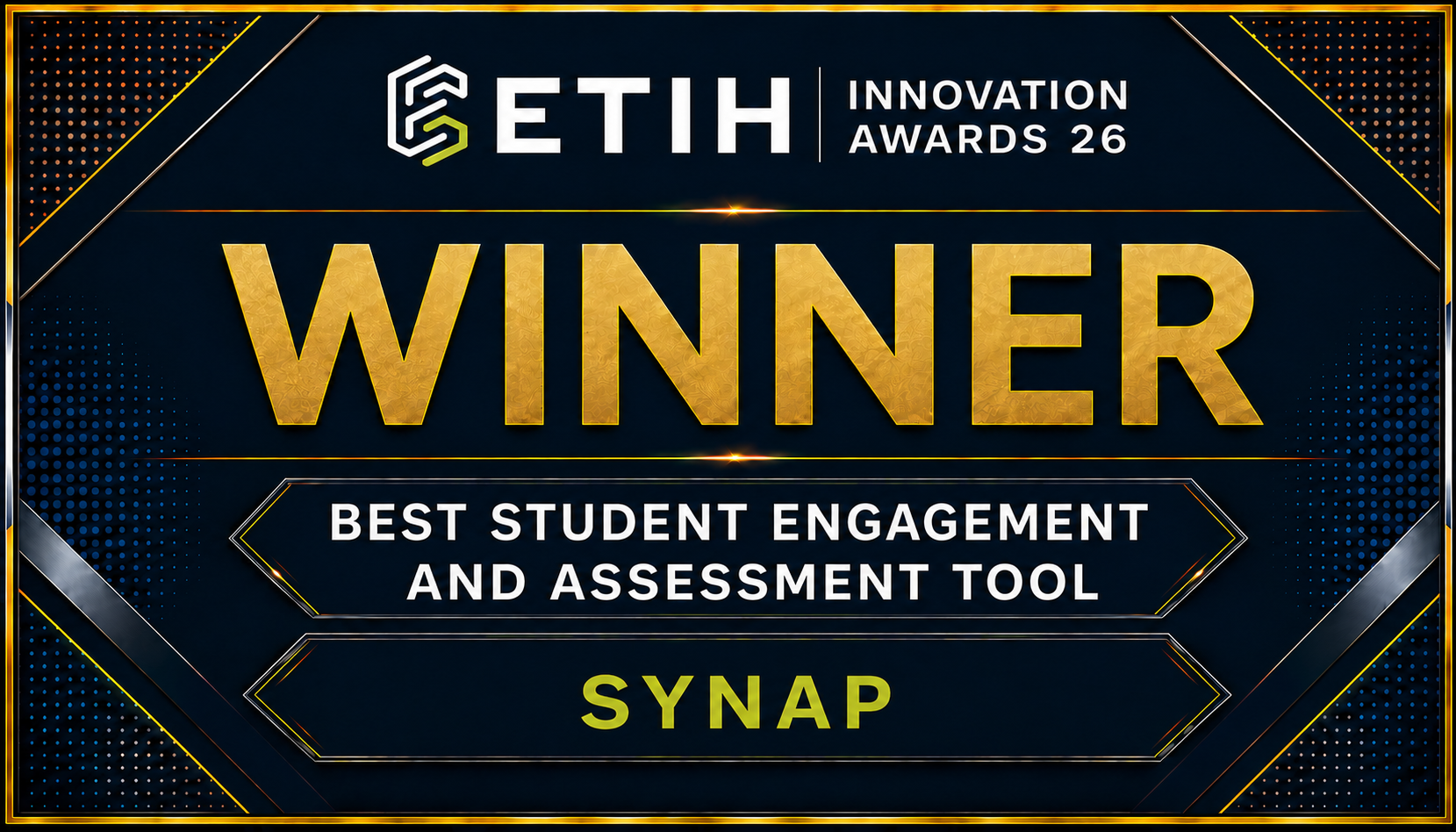
Synap won Best Student Engagement and Assessment Tool at the ETIH Innovation Awards 2026
Synap has won two categories at the ETIH Innovation Awards 2026, taking home Best Student Engagement and Assessment Tool and EdTech Company of the Year (UK).
The online learning and assessment platform was recognized for its work with the University of Law, where Synap has become part of how students prepare for the Solicitors Qualifying Examination, not just a place to sit tests.
Diagnostic assessment, short daily practice, spaced learning, mock exams, and predictive analytics are used together to help students build exam readiness throughout the course. Behind that sits a model built around the habits students form before high-stakes assessment, and the signals tutors need before a student reaches the point of failure.
The project draws on Synap’s origins in medical education. Before moving into legal training, Synap was developed around the kind of high-volume, multiple choice exam preparation used by medical students. That experience became relevant when the Solicitors Qualifying Examination changed the route to legal qualification in England and Wales, bringing with it a demand for sustained, structured, and data-led preparation.
The University of Law now uses Synap across 15 campuses. According to the entry, around 50 percent of law students in the UK preparing for the Solicitors Qualifying Examination use the platform daily, turning practice questions into a regular part of study rather than a last-minute revision exercise.
Synap’s predictive model analyzes 50 performance and engagement metrics. According to the entry, it predicts whether a student is likely to pass or fail with 98 percent accuracy, giving tutors a clearer view of who may need support while there is still time to intervene.
From medical exams to legal assessment
Synap’s move into legal education was shaped by a clear overlap between medical licensing exams and the Solicitors Qualifying Examination. Both rely on high-volume, structured assessment, but both also require students to use knowledge under pressure rather than simply recall facts.
Dr. James Gupta, CEO of Synap, says the SQE’s design meant Synap could apply lessons from its earlier work in medical education: “The SQE took cues from structured assessments in the medical sector, such as the USMLE and undergraduate exams here in the UK, so there’s definitely a lot of principles that we were able to carry over from our previous experience in medicine.”
That experience helped Synap approach the Solicitors Qualifying Examination as more than a content challenge. The question was how to build a learning routine around a demanding assessment format, while still giving tutors enough visibility to support students at the right time.
Gupta adds: “There’s a misconception around MCQs that they are ‘easy’, but if done properly they can be very challenging and really test student’s ability to apply their knowledge, not just to recall information.”
The University of Law needed a system that could cover diagnostic assessment before a course begins, thousands of practice questions during study, weekly formative assessment, summative assessment, and mock exams that simulate real Solicitors Qualifying Examination conditions.
Synap provides a question bank of 5,000 questions organized by topic. Students can work through short practice sessions on any device, while spaced learning and personalized recommendations surface weaker areas over time.
ETIH Innovation Awards judge Neil Almond pointed to that structure, saying Synap “uses a powerful spaced learning algorithm coupled with a diagnostic assessment to support those studying for the SQE.”
The platform also includes single sign-on, automated reminders for missed weekly tests, question highlighting, and annotation tools introduced in response to student feedback.
Kate Owbridge, ETIH Innovation Awards judge, connected Synap’s earlier medical education work to its move into legal training, saying the platform had “already proven its effectiveness through the use in the medical training field” and was now “moving into law.” She also described the link with human tutors when students fall behind as “a great failsafe.”
Practice data before the point of failure
Synap’s University of Law project is built around the idea that self-directed study data can be useful before a final assessment, but only if it is interpreted carefully.
The platform captures activity from casual daily practice, weekly tests, formative assessment, summative assessment, and mock exams. That data is then used to identify students who may need support and to show where tutor intervention should be focused.
Gupta says the predictive model gives tutors and students a more useful view of preparation than one-off assessments alone: “The predictive model provides a really valuable, data-informed way for tutors to assess how their students are doing, and crucially, it allows them and the students to make an informed decision about what they should be doing differently, and when the optimal time for that student to sit the SQE exam is.”
The predictive model looks beyond a single score. Gupta says it is based on a range of factors, including consistency and engagement, making it less dependent on one assessment moment.
He adds: “Traditionally, institutions rely on formative assessment to estimate how a student, or cohort, is progressing and their preparedness for the final exam. The problem with this, particularly on an intensive, short course such as the SQE, is that the data often comes too late in the course to make early, targeted intervention when they would have the most impact.”
Catherine Buckler, ETIH Innovation Awards judge, said Synap “added significant value through the use of technology to identify those who may need additional support,” helping tutors direct their time “in the most impactful ways.”
That ability to turn study behavior into clear tutor insight was a major theme in Synap’s entry. A student with lower scores may be focusing deliberately on weaker areas. A student with higher scores may be repeating familiar topics. Raw scores alone can miss both patterns.
Gupta says multiple choice questions are valuable because they create learning data that can be analyzed at scale: “A single MCQ response tells you: ‘This student got that question correct’ - but then there’s so much you can do with thousands of those data points. They can be analysed over time, by subject or topic, between different students or cohorts. This leads to genuinely actionable data and is the foundational part of most of our analytics.”
For Synap, the challenge in learning analytics is no longer whether data can be collected. It is whether the resulting insight changes what students and tutors do next.
Gupta puts it directly: “The question is ‘what do we do with it’, and ‘how can we present this in a way that is actionable and changes behavior’ as opposed to just providing graphs and charts which look pretty.”
Daily engagement and exam readiness
The University of Law described Synap as part of students’ regular learning journey, not only a formal assessment platform: “Innovation for the improvement of learning is central to ULaw's ethos and our students expect the best and latest tools, such as Synap, to enable them to achieve their goals.”
They added: “Our students find that Synap is a central part of their journey with us and most use it on a daily basis.”
That daily use was central to the entry. Students regularly complete tens of thousands of questions on the platform, with engagement closely associated with stronger exam outcomes, according to the submission.
Gupta says Synap’s thinking around exam preparation has always started with regular practice: “Our core assumption with the exam preparation side of Synap, is essentially “practice makes perfect” - that is to say, engagement - practicing questions - will increase the chances of success.”
Synap’s approach is deliberately flexible. The platform encourages practice, but it does not prescribe one timetable or route through the material.
He adds: “People study in different ways and one of the great thing about Synap is that it isn’t prescriptive - we don’t tell you when you should be studying or for how long, we just think that ‘more is better’ and our platform tries to make it simple, fun and engaging.”
That flexibility also explains why Synap’s analytics do not treat every study pattern in the same way. Self-study data can be useful, but only if it reflects how students actually revise, test themselves, avoid topics, revisit material, and build confidence over time.
Gupta says self-study data is “messy,” and Synap has had to develop ways of analyzing large volumes of activity without penalizing students for different approaches to learning.
Jack Dowling, ETIH Innovation Awards judge, described Synap as “quietly the most technically innovative submission,” noting that while its scale was smaller than some other entries, “the engineering value could lead to some huge benefit.”
Expanding the assessment model
Emma Thompson, Director of Content and Editor at ETIH, says: “Synap’s entry showed how assessment data can become part of student support rather than something institutions only look at after the fact. What made the University of Law project compelling was the connection between daily practice, predictive insight, and timely tutor intervention.”
Synap is now being evaluated for expansion to Solicitors Qualifying Examination 2, the applied skills component of the qualification. That would extend the model across more of the legal qualification pathway.
For Synap, the two ETIH Innovation Awards recognize both the University of Law project and the wider direction of the platform.
Gupta says the recognition means a lot to a small team that has invested heavily in the University of Law project: “We’re delighted and very grateful to have won the ETIH Innovation awards this year! We are incredibly proud of the work we do and the SQE project in particular is something we put a lot of time and effort into. For us, as a small team it’s always nice to have some external recognition and validation for those efforts.”
The company is also looking beyond legal education, as online assessment changes again in response to artificial intelligence and new expectations around secure digital exams.
Gupta adds: “In terms of what’s next for us - this is an incredibly exciting time to be in the online assessment space, a few years ago with COVID we saw a huge shift in the way institutions think about delivering assessments, and now with the increasingly widespread use of AI we’re in the middle of another significant shift in how online assessments are secured and delivered.”
Synap’s focus is now on becoming a broader platform for online assessment and learning, while keeping the student experience central to the product.
Gupta says: “We are focused on making Synap the ‘go to’ platform for online assessment and learning, and we’re very proud of the fact that students can do both on our platform - e.g. they can use Synap as their personal learning tool, and then sit their exam on a platform they are already familiar with. As we grow, we want to retain that ‘student first’ thinking and DNA which led to us creating the platform in the first place, whilst also expanding our offering to institutions who are looking to deliver their exams securely online.”
To find out more about Synap, more information is available via the company website.