UCL to lead open-source AI lab in £60m UKRI research program
SOFAIR will work with Cambridge, Oxford, and Edinburgh on alternative AI architectures, while a second lab will examine how AI systems learn.

UCL will lead the SOFAIR Lab, which will develop open-source AI models and investigate alternatives to current AI architectures
UCL will lead a new national research lab focused on developing open-source artificial intelligence systems that can operate on more widely available computing infrastructure.
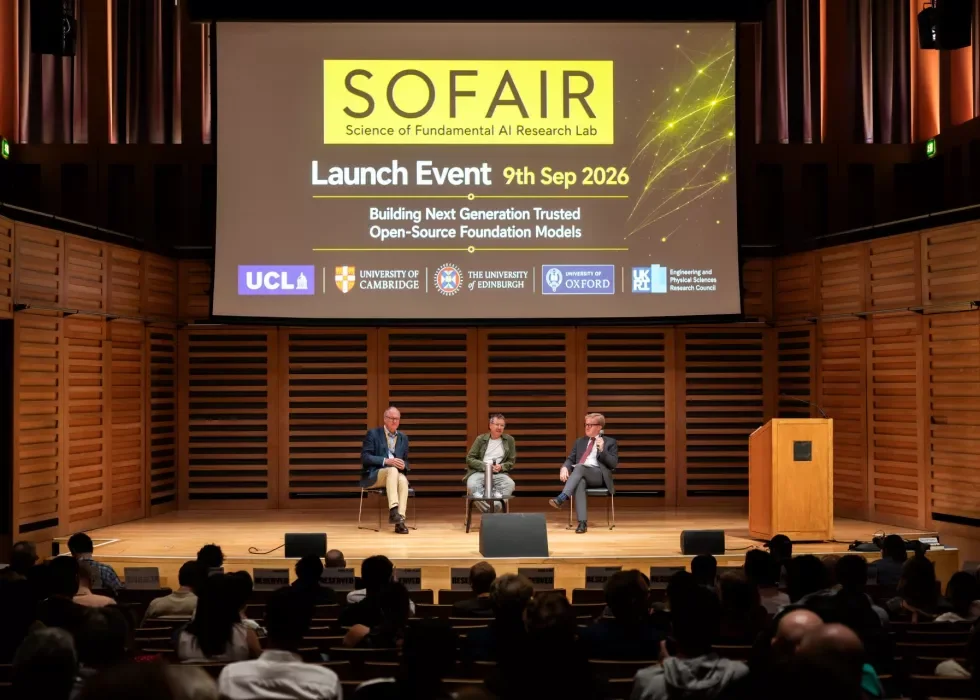
The Science of Fundamental AI Research (SOFAIR) Lab was formally launched in London on June 23 and will bring together researchers from UCL, the University of Cambridge, the University of Oxford, and the University of Edinburgh.
SOFAIR is one of two labs being created through a £60 million program funded by UK Research and Innovation’s Engineering and Physical Sciences Research Council (EPSRC). Each lab will initially receive £8 million, with further funding available after an assessment in autumn 2026.
The UCL-led lab will examine alternatives to the small number of architectures that underpin many current AI systems. Its researchers will draw on computer science, mathematics, statistics, and neuroscience to develop open-source models and systems designed to run on commonly available hardware.
A second lab, the British Open-ended Learning and Discovery (BOLD) Lab, will be led by the University of Oxford with involvement from UCL and Imperial College London. BOLD will focus on how AI systems learn, interact with people, and operate in physical environments without relying on large centralized computing resources.
SOFAIR will test alternatives to current AI architectures
Professor David Barber of UCL Computer Science will lead the SOFAIR Lab. The research will address limitations in current AI systems, including inaccurate responses and the concentration of model development around a limited group of architectures and providers.
Professor Barber says: "We’re very excited that UCL will be leading the new SOFAIR Lab. While current AI systems are impressive, many still suffer from basic issues such as inaccurate responses to questions. These systems often use similar underlying architectures, so SOFAIR will bring together the broader sciences and fresh ideas to create a new generation of open-source models. This will reduce dependency on the small number of model providers, boosting UK sovereignty and its position as a global player in AI."
SOFAIR will explore AI technologies that require less specialized and expensive computing infrastructure, with the stated goal of making advanced systems more accessible to researchers, universities, public bodies, and other institutions.
UCL says the lab will build on its existing AI research, including work spanning healthcare, education, public services, science, and industry.
The university has also linked the lab with its AI for People and Planet framework, which covers AI development, safeguards, and the social impact of the technology.
Oxford-led lab will examine how AI learns
The BOLD Lab will take a separate approach by examining how AI systems can move beyond current training and deployment methods.
The Oxford-led research will consider systems capable of working alongside people, responding to real-world complexity, and operating within physical environments.
BOLD will also investigate whether AI systems can perform these tasks without the large centralized computing resources associated with many current models.
Both labs are expected to develop partnerships across universities, industry, and the public sector.
The program also includes support for turning research into commercial products and university spinouts, although no commercialization targets, company formation goals, or delivery timetable have been published.
Kanishka Narayan, the UK’s AI and Online Safety Minister, formally launched SOFAIR at the Royal Academy of Engineering in London.
The launch took place on what would have been mathematician and computer scientist Alan Turing’s 114th birthday.
Further funding depends on autumn assessment
Professor Geraint Rees, Vice-Provost for Research, Innovation and Global Engagement at UCL, says the lab will focus on research that may not yet attract commercial investment: "Commercial AI labs are, understandably, focused on near-term applications. SOFAIR exists to do the work they can’t: fundamental research into the structural limits of current AI systems, work that benefits UK citizens but doesn’t yet have a commercial market.
“EPSRC’s investment in this area reflects how seriously the UK is taking foundational AI research. UCL is proud to be part of that effort, and we intend to use SOFAIR to ask harder questions about AI than the market currently has any incentive to ask."
Professor Charlotte Deane, Senior Responsible Owner for the UKRI AI Programme and Executive Chair of EPSRC, says: "These labs will put that advantage to work, backing the bold, high-reward ideas that can shape the future of AI. We look forward to working with the labs to maximise the benefits for the UK."
SOFAIR and BOLD will each begin with an £8 million allocation. EPSRC will assess their progress in autumn 2026 before deciding how further funding from the £60 million program will be distributed.