Bett UK 2026: Bridget Phillipson says AI could be biggest shift in learning since printing press
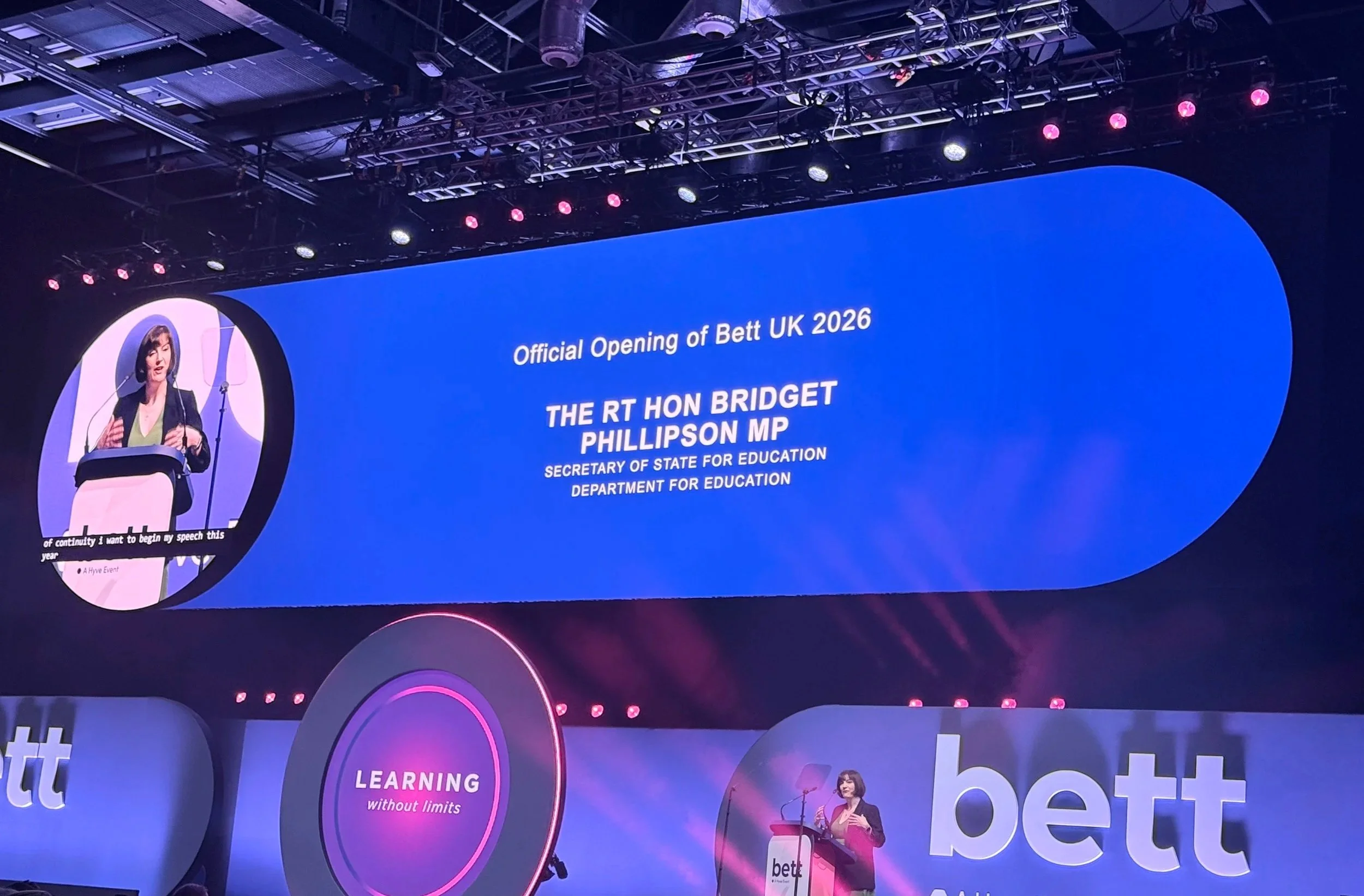
Speaking on the opening morning of Bett UK, the Education Secretary told delegates that artificial intelligence could represent the most significant change to education “perhaps even since the invention of the printing press,” as the government set out how it plans to scale AI across schools while tightening safeguards for children.
With AI dominating conversations across the show floor on day one, the address framed Bett as a global convening point for education systems grappling with rapid technological change, with the Secretary noting that the event’s influence now stretches well beyond the UK.
“Your impact is felt not just by learners here in Britain, but right across the world,” she told the audience.
AI, inclusion, and SEND support
A central focus of the speech was how AI could support inclusion, particularly for students with special educational needs and disabilities, without displacing educators. The Education Secretary highlighted the work of a specialist teaching assistant, Dawn, explaining how AI tools are already helping staff adapt lessons more quickly and responsively.
“With the use of AI, the classroom becomes a more inclusive place where all children can achieve and thrive. AI makes that possible,” she said.
She was clear that technology must remain an enabler rather than a substitute. “AI and EdTech can never, and will never, replace what Dawn does. But it can help her,” she added.
That distinction between human expertise and technology ran throughout the address, with repeated emphasis on teachers as the foundation of the education system.
“There is nothing that changes a child’s life like a great teacher at the top of their game,” she said. “AI can do a great deal, but it will never replace the human light of learning passed from one generation to the next.”
Safety standards and global coordination
Alongside the push for adoption, the Secretary stressed that AI use in education must be safe, describing this as “non-negotiable.” She confirmed that earlier in the week she had convened international education leaders to discuss generative AI, using the meeting to launch updated safety standards for schools.
“These standards cover everything from emotional and social development to mental health, from promoting positive content to restricting exploitative material,” she said.
She welcomed the involvement of major technology firms, noting that companies including Google, Microsoft, and Pearson are already working with government to meet those expectations. “That matters, because we do not want our children caught on apps or screens for longer than is necessary for their education,” she warned.
The speech also addressed growing concern around screen time, social media, and mobile phone use, drawing a clear distinction between consumer platforms and education-focused tools. “We all know that mobile phones have no place in our schools,” she said. “But AI learning tools are different.”
The government will consult on further protections for children online, including restrictions on addictive features, improved age checks, and limits on social media access. Guidance on screen time in early years settings is also due, aimed at supporting parents to balance technology with activities such as talking, playing, and reading.
Five national goals for AI in education
At the core of the keynote was the announcement of five goals that will shape the government’s approach to AI in education.
The first centres on students, with a commitment to ensuring every child leaves school equipped with digital and media literacy skills. As part of this, the government will explore a new level three qualification in data science and AI following the curriculum and assessment review.
The second goal focuses on the workforce, supporting teachers and support staff to use AI and digital tools confidently, reduce workload, and spend more time teaching.
The third relates to teaching and learning, prioritising safe and effective AI tools shaped by classroom realities. The Secretary pointed to Oak National Academy’s AI lesson assistant as an example of keeping teachers in control while saving time.
The fourth goal addresses data, with plans for a more connected school system built on open standards to unlock insights currently held in closed platforms.
The fifth goal commits to safe and reliable infrastructure, including high-speed internet across schools.
Funding, trials, and evidence
To underpin those ambitions, the Education Secretary confirmed additional investment to expand the national EdTech testbed programme, with £23 million allocated to extend trials over four years. The expanded programme will recruit schools and colleges to test AI and EdTech tools in live classroom settings, tracking their impact on both teaching practice and student outcomes.
“We will track how these tools perform, the difference they make for teachers, and above all, the difference they make for children,” she said.
She repeatedly cautioned against using AI as a shortcut in learning. “AI cannot be about making things easy,” she said. “It must be about helping children rise to the challenge of learning.”
Further funding was highlighted for assistive technology, including £1.6 million for pilot lending libraries supporting students with SEND. She cited examples of non-verbal students gaining access to communication devices that allow them to participate more fully in lessons.
“One parent told us it has made her daughter happier in the classroom. She is more confident now that she can make herself understood,” she noted.
UK positioned as global EdTech hub
The Secretary closed by positioning the UK as a leading force in global education technology, linking EdTech to the government’s wider international education strategy.
“The UK is an EdTech powerhouse,” she said. “We export learning around the world.”
She confirmed that a forthcoming Schools White Paper will set out the government’s longer-term direction for education into the 2030s, with AI framed as a tool to narrow, rather than widen, the disadvantage gap.
Taken together, the announcements signalled a clear direction of travel from day one of Bett: rapid AI adoption, tighter safeguards, and a policy focus on using technology to support teachers, include more learners, and ground innovation in evidence rather than hype.
ETIH Innovation Awards 2026

The ETIH Innovation Awards 2026 are now open and recognize education technology organizations delivering measurable impact across K–12, higher education, and lifelong learning. The awards are open to entries from the UK, the Americas, and internationally, with submissions assessed on evidence of outcomes and real-world application.