Anthropic lets Claude users see how they really use AI over time
New Reflect dashboard gives eligible Free, Pro and Max users a monthly view of their Claude usage, AI fluency patterns, quiet hours and break reminders.
Anthropic has introduced a Reflect dashboard for Claude users on Free, Pro and Max plans.
Anthropic has introduced a Reflect dashboard for Claude, giving users a way to review how they use the AI assistant across work, study and daily tasks.
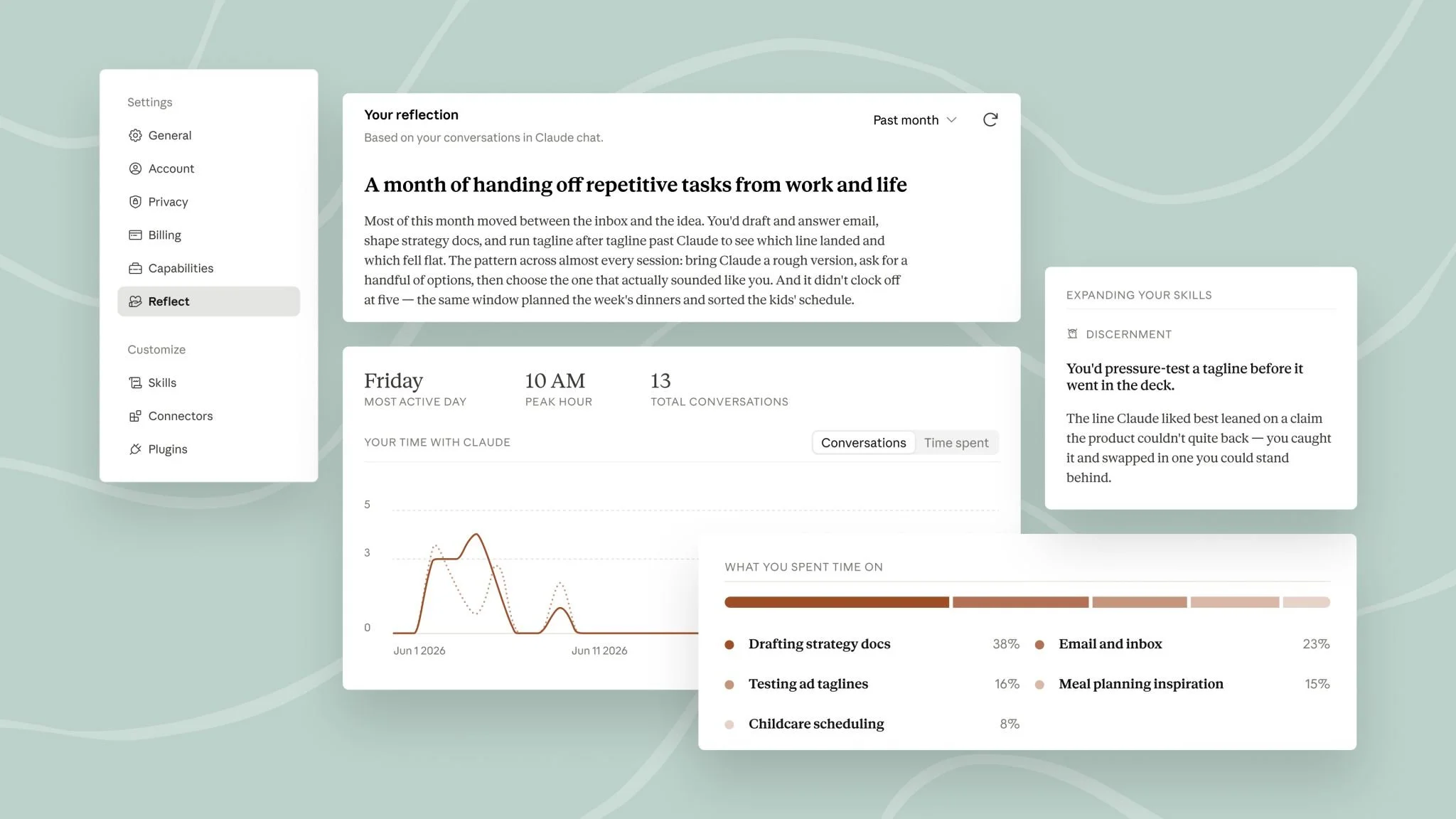
The feature was announced on July 9 and is now available in beta on Claude for web and desktop for Free, Pro and Max users with Memory turned on. It appears in Settings under Reflect and can generate a usage recap based on Claude conversations from the past one, three, six or 12 months.
The launch adds a self-review layer to Claude at a time when AI tools are being used across education, workplace learning, writing, planning and administrative workflows. Anthropic framed Reflect around a practical question for AI users: not just whether they are using AI, but how they are using it and where it fits into their own decision-making.
Reflect shows Claude usage patterns
Reflect summarizes the topics users have worked on in Claude, when they use the assistant most, and the types of tasks that appear most often in their conversations.
In the example shared by Claude, the dashboard shows a monthly recap covering email drafting, strategy documents, tagline testing, meal planning and childcare scheduling. It also displays the most active day, peak hour and total conversations.
Anthropic said the dashboard is designed to help users “track and visualize how you use Claude, and decide whether that time aligns with your goals.” A future update will add a view showing how much time users have spent using Claude.
Reflect also includes prompts that ask users to think about the role Claude plays in their work and life. One example asks: “What's one thing you want to keep doing yourself, even if Claude could do it faster?”
Users can respond to those reflection prompts in Claude. The dashboard also lets users set quiet hours or schedule a nudge to take a break after a chosen amount of time. Anthropic described both features as reminders of the user’s own preferences, which can be dismissed.
Feature uses 4D AI Fluency Framework
Reflect also connects Claude usage to Anthropic’s 4D AI Fluency Framework, which covers delegation, description, discernment and diligence.
Anthropic defines delegation as setting goals and deciding whether and how to use AI. Description focuses on how users explain goals in prompts. Discernment covers how users assess AI outputs and behavior. Diligence focuses on user responsibility for what they do with AI and how they do it.
The dashboard gives users examples of how they appear to collaborate with Claude. Anthropic said this could include noting that a user often rewrites email drafts in their own voice, or that they only delegate tasks to Claude after working through the strategy themselves.
The feature can also suggest practical workflow changes. Anthropic gave the example of starting a Project instead of repeatedly explaining the same context to Claude.
Kristen Swanson, who works in AI fluency research and learning, highlighted the launch on LinkedIn, writing: “If you're a Claude user, this new feature allows you to explore what your AI fluency (delegation, description, discernment, and diligence) looks like over time.”
Anthropic outlines privacy limits
Anthropic said Reflect does not use incognito chats, underlying files from connected tools, or conversations connected to a health integration tool.
The distinction around connected tools is specific. Anthropic said that if a user asks Claude to summarize an inbox, the summary may appear in Reflect, but the source emails would not.
Anthropic also said Reflect information stays within the feature and is not used for any other purpose. Sensitive conversations may appear in the dashboard, but only at a high level.
Anthropic said it worked with digital media and wellbeing experts from the MIT Media Lab’s Advancing Humans with AI program, the Digital Wellness Lab at Boston Children’s Hospital, and the Family Online Safety Institute while developing the feature and its approach to sensitive topics.
Reflect is available now in beta for Claude Free, Pro and Max users on web and desktop, provided Memory is turned on. Anthropic said reflection support for Cowork conversations will be available soon.